Waves in the sea.
As we all know, humans have spent their time on this planet evolving for a life of observation through air. Two ears give us the ability to detect sound waves at different times, therefore determining the direction of the source. Our two eyes are specially evolved for detecting light rays of different wavelengths in the ‘visible’ waveband, giving us colours, and our is cornea shaped so that we can focus the light effectively into a crisp image in our brains.
However replace air which is relatively low density and elasticity with salt water, which is much higher in those parameters, and suddenly everything changes. Sound waves travel four times faster in water, as it is much more elastic than air, and is why low frequency sounds like whale vocals can travel for kilometers.
I have never heard a whale underwater but one of my dreams is to share the water with the holy grail of acoustics – the sperm whale. I was lucky enough to see them from a boat in Mauritius, which in hindsight was one of the first moments I felt like Alice being pulled through the looking glass into the ocean world I’m in today.
The peculiar thing about underwater sound is that due to its higher speed, our ears are not evolved to detect such a minute difference in time between left and right, so you are totally unable to direct the source of the noise. It is a very bizarre phenomenon when a boat passes overhead, because it sounds like it could be below you as much as it sounds like it is passing above.
Light is just as, if not more complex in its behaviour than sound underwater. Have you ever thought why everything is blurry underwater, but as soon as you put a mask on, it becomes crystal clear again? The answer is all due to the evolution of the human eye, and a physical principle called Snell’s law.
When light passes from air into pupil, there is a critical angle of refraction (bending) that focusses the light perfectly behind the retina, however from water to pupil, the angle of bending is much different and the light is not focused into a crisp image on the retina. That is purely the function of a mask; to provide a layer of air for light to pass through before entering the eye.
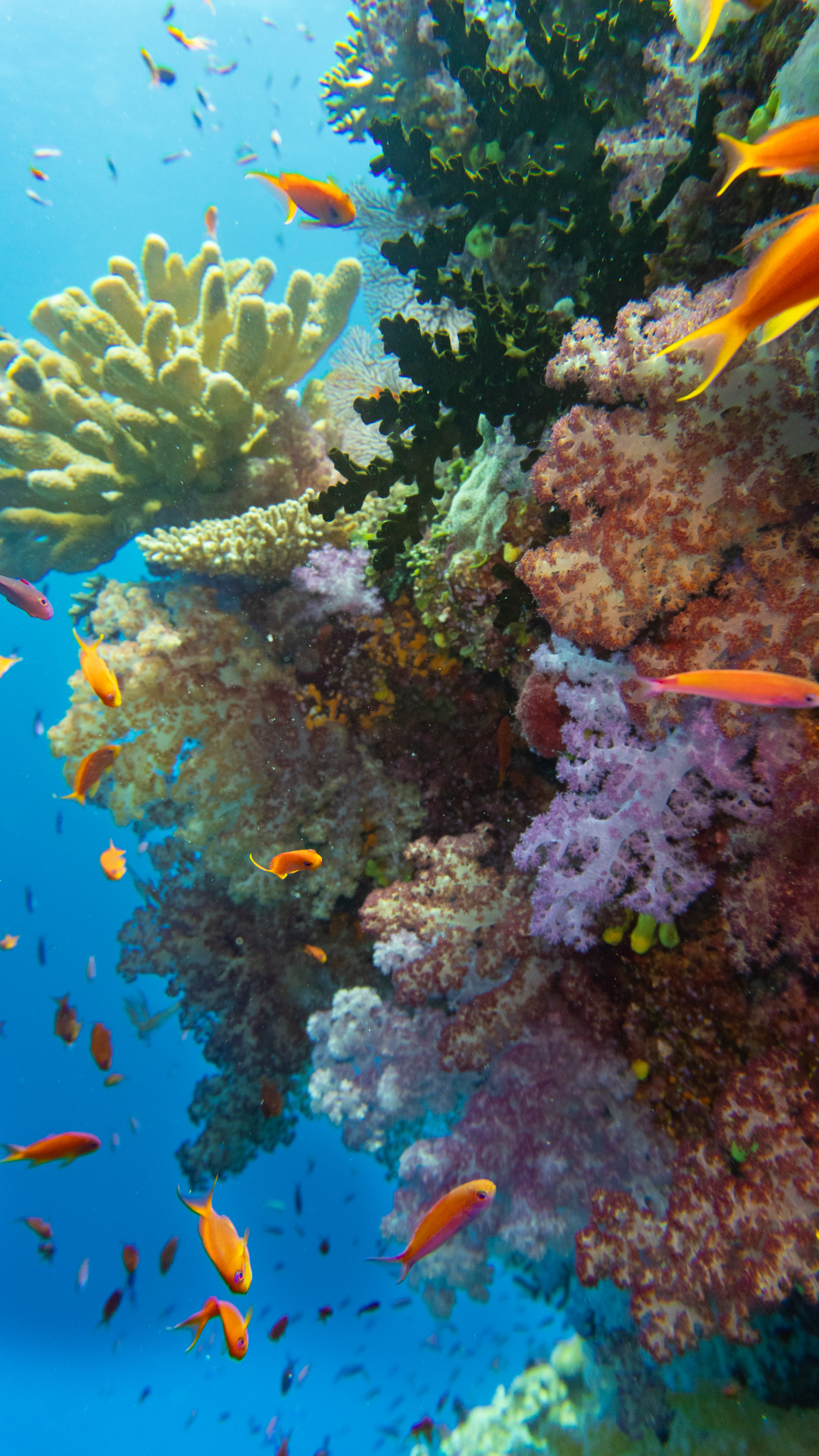
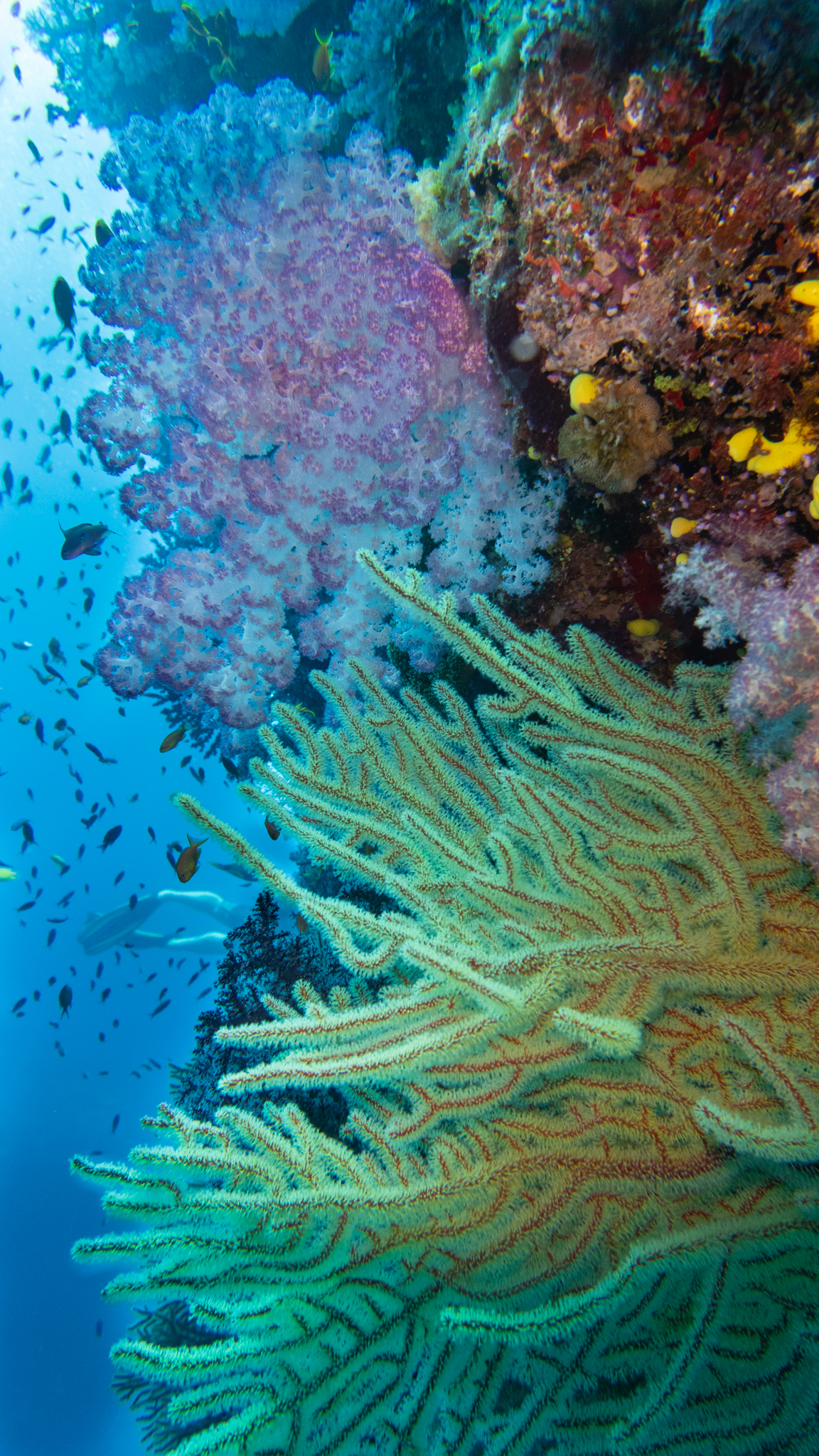
Two of my favourite photos that I have ever taken remind my how fortunate I am that something as simple as wearing a mask allows us to see such fine and complex shapes beneath the waves.
Fish and other marine creatures have evolved to cope with this, so their vision in water is crystal clear like animals on land. However remove them from their soup and they suffer the same blurry vision as we do underwater.
Where did all the red go?
Everyone knows the sea is blue. Unless you grew up in the same place as me, in which case it can be brown too… However clear, deep water is famous for its colour, but why is it not red? Or green? Or yellow? As usual, the guardian of the secrets of our planet will reveal their truths through physics…
A common misconception is that it is linked to the blue sky, which isn’t the case. Nitrogen in the atmosphere is the cause of the sky’s wonderful colour, but the ocean is predominantly water molecules which are entirely different. Water molecules absorb nearly every wavelength of light incredibly quickly, except for the blue wavelengths which can pass through more effectively, leaving them as the only ones for our eyes to detect, and giving deep water its empty, cold, blue hue.
This is also why many forms of life underwater appear green and blue, because the red has simply been absorbed by the water before it reaches our eyes. This can create problems for photographers wanting the shoot vivid scenes underwater, as everything comes out in these tones, and is why photographers and night clubs have something in common: strobes.
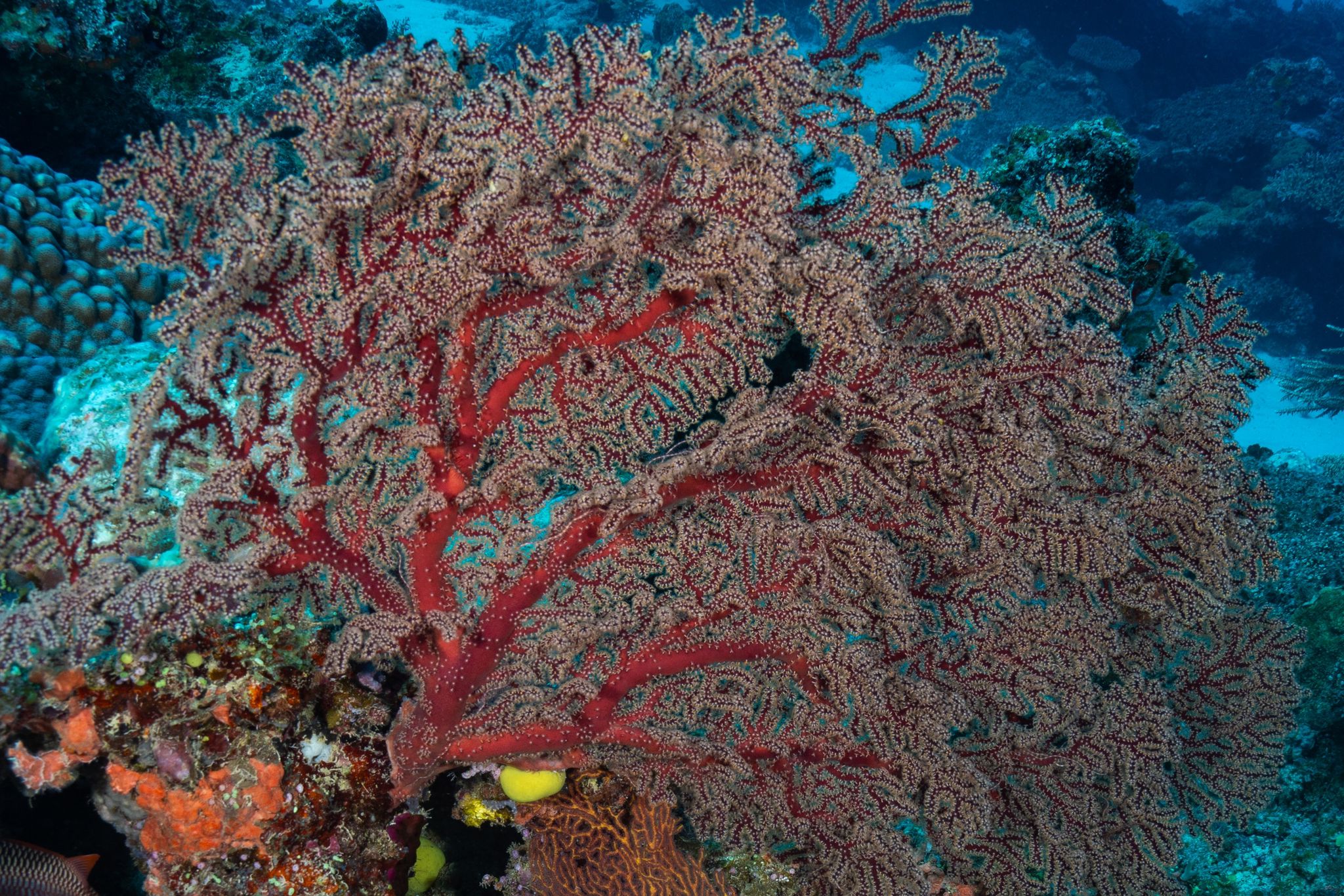
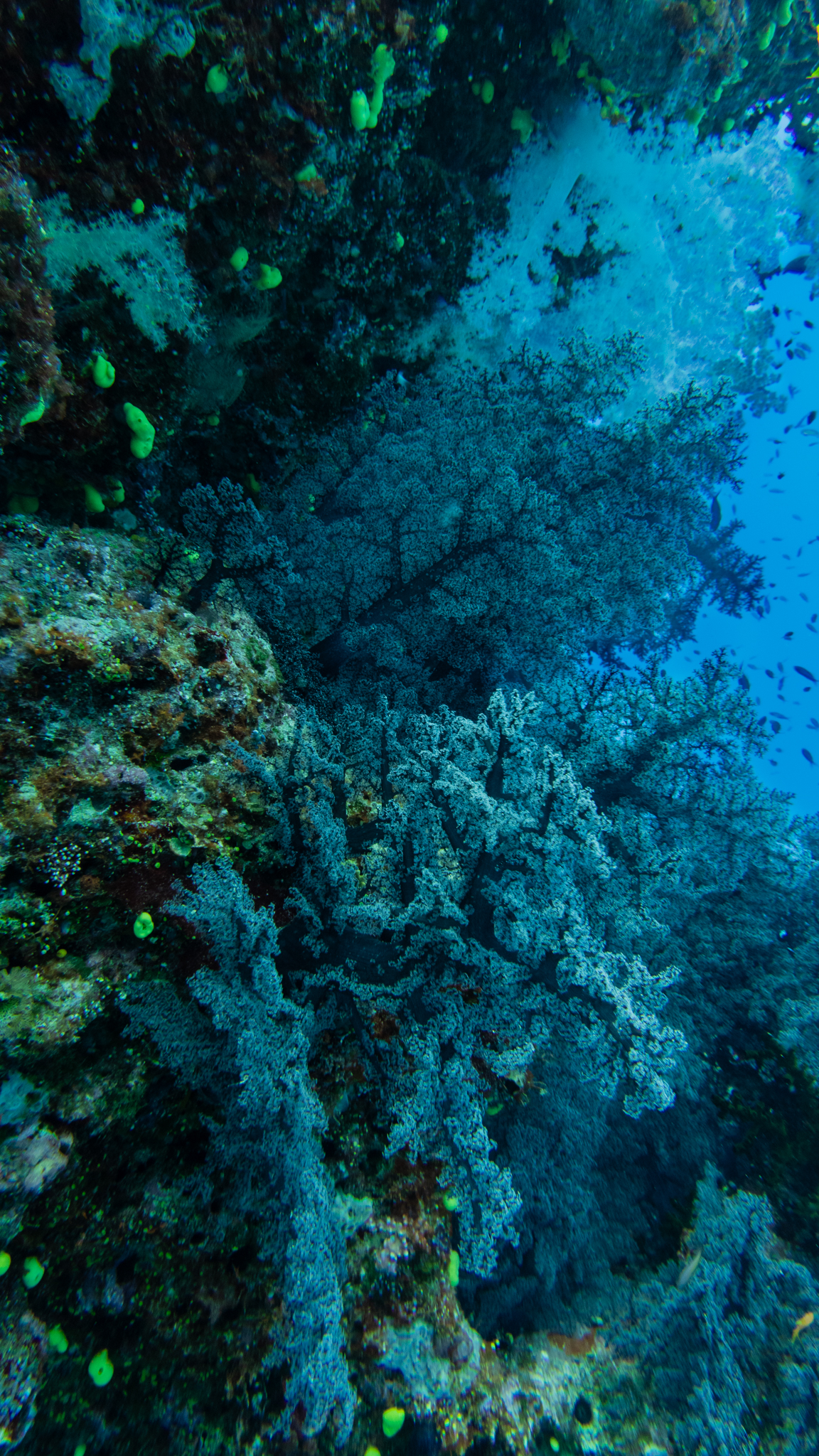
Above are two different corals, a sea fan (just like me, I’m a big fan of the sea hehe) on the left which was shot using artifical lights, and soft Dendronephthya on the right, shot using only natural light.
The difference, as above, demonstrates the use of artificial light underwater. The function of a strobe is to restore the red wavelengths, as the distance they must travel is only from the strobe, to the subject, and back to the lens, reducing the amount that are absorbed by the water.
Whereas those that are lost by natural lighting, must pass through all the water between your eye and the surface. As you can see, strobes create a very different view to what your eyes normally detect. Despite being different species, they appear almost identical in colour to our eye underwater when artificial lighting is absent.
This style of photography has consequences in my opinion. Nothing serious, but simply a misconception. Many people see stunning photos of corals taken by brilliant photographers who use strobes, and while these photos often inspire more people to adventure through an underwater paradise, many people see their first reef with a much different colour palette, and ask: “Were all of those corals dead?”
Here is a clear example of the colours we like to see on a healthy coral reef, taken using only natural light.
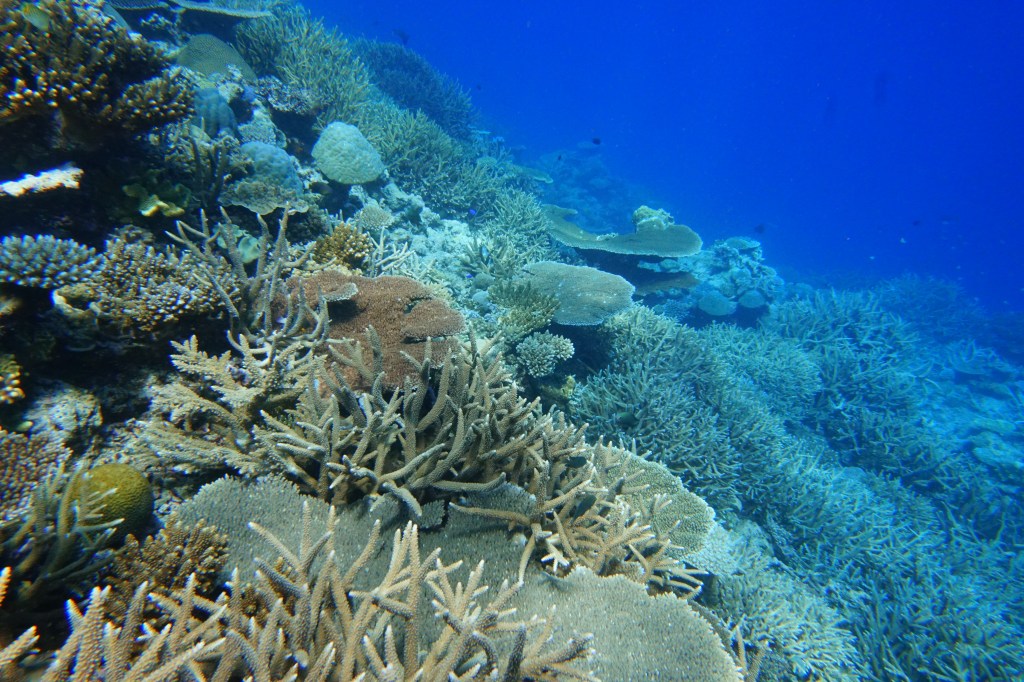
Make no mistake, one small square of our healthy reef can be like looking at the fruit stand at the market. Wrasse more orange than a ripe tangerine navigate through a maze of raspberry soft coral above the sponges which can be mistaken for lemons or red grapes.
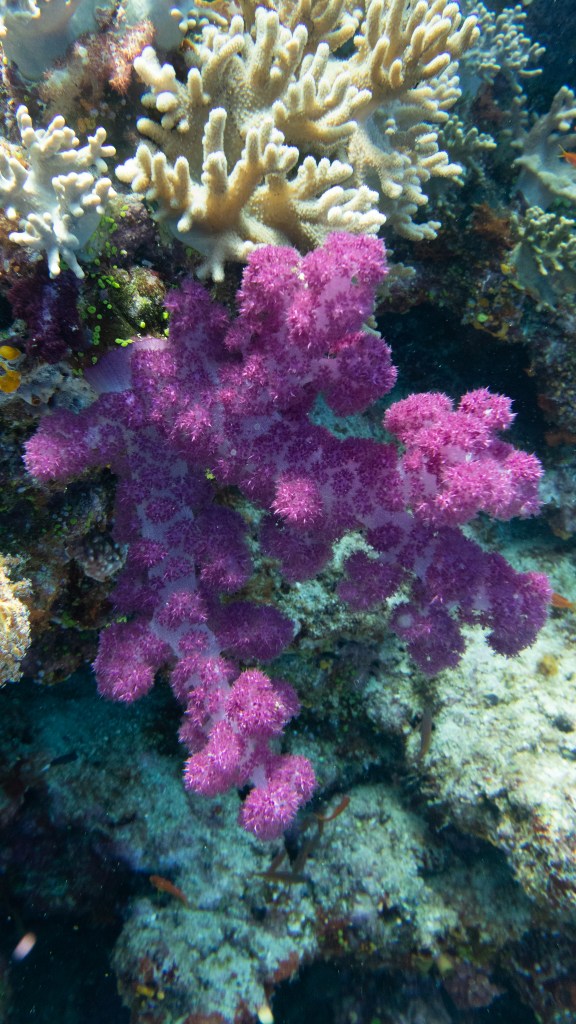
The sweet, sugary purple in this soft coral is the epitome of Fiji diving, and is what draws the eyes of diving tourists from all corners of the globe.
Making the most of what you have.
The critters I get most excited about seeing, probably all saw me first, thanks to their superior aquatic evolution that always puts my clunky movements, poor underwater vision, and noisy breathing equipment to serious shame.
Many sharks which use vision in areas with limited light have an incredible ability to use a layer of crystals behind their retina to reflect light back into the sensitive cells, effectively giving the available light twice the opportunity to be detected by the retina, and making their vision even stronger!
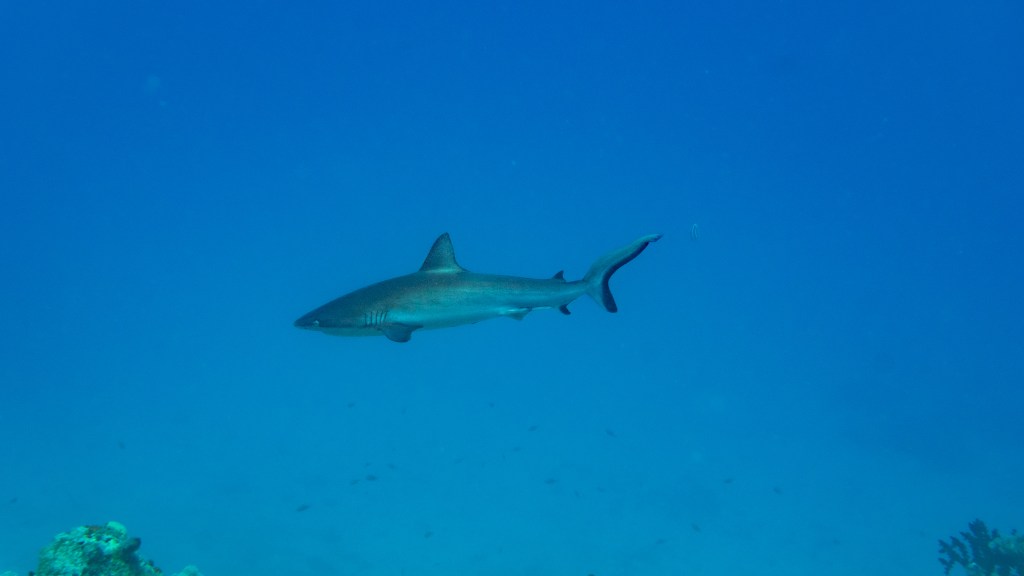
I can confidently say this shark is one I can recognise every time we share the water. Any guesses how I know it is the same one each time? I am also taking submissions for name recommendations!
Perhaps the most powerful product of evolution to make the most effective use of underwater light comes in the surprising form of a crustacean- not typically associated with great eyesight!
The mantis shrimp grows to about the size of a small forearm and lives in vertical holes in the sand where they wait with their eyes peering upward like a submarine’s periscope, waiting patiently for their prey to get too close before they unleash one of the fastest strikes in the whole animal kingdom, either clubbing like an angry caveman or spearing like a skilled swordsman.
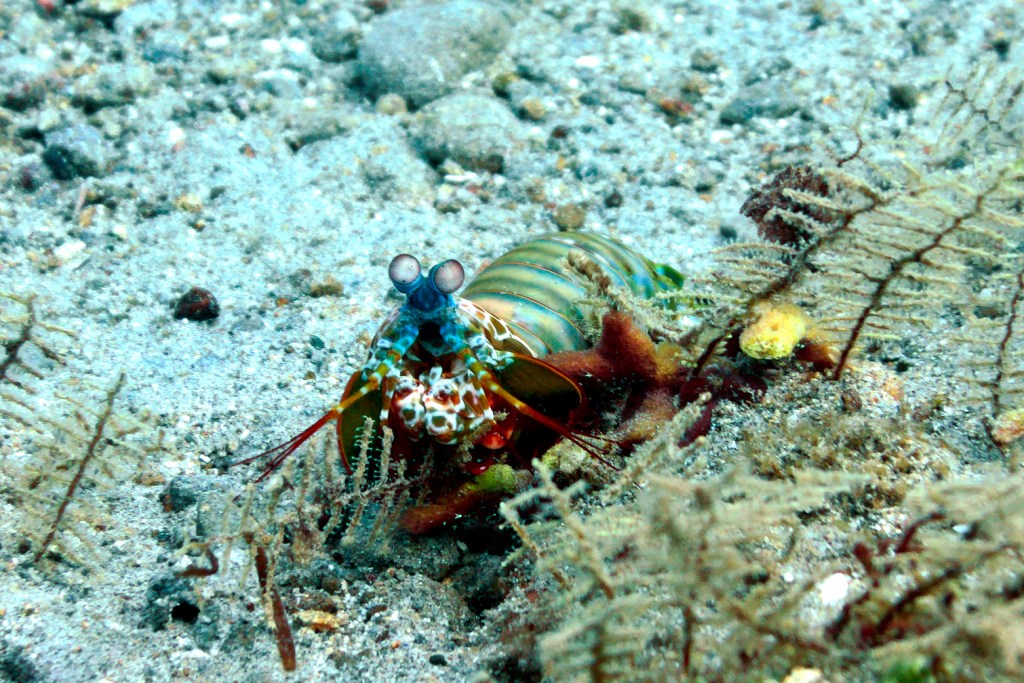
They are very timid, and it is rare to see them venturing outside the protection of their den, I was very lucky to catch this peacock mantis out in the open during a dive in Indonesia.
As you can see from the photo, their eyes are as extra-terrestrial as the shape and colour of the rest of its body. They visualise their world totally differently to us thanks to those eyes which look to us like television static.
For context, humans have three types of photoreceptive cells to detect colours, red, blue, and green, but these crustaceans have 16 (that is not a typo!) different light receptors all tuned to a different wavelength of light! Colours we can’t even imagine! I applaud any fish able to evade the cunning and speed of this fabulous creature.
Surgeons like blue too!
In my two most recent weeks of diving, I have observed some new behaviour on the reef!
Surgeonfish are almost perfectly ovular in shape with a ‘C’ shaped tail which trails off into two fine strings which mark their perfectly sinusoidal swimming motion like long ribbons in the wind.
The common species I see at Dreamhouse is the orange-spine surgeonfish (Naso lituratus). The body of the fish is dark like the sky on a cloudy night, but is contrasted with a vibrant sky-blue dorsal fin and a sunset orange anal fin, and their face is delicately painted yellow.
What has caught my attention about these fish, is their courting behaviour. I am yet to determine if the male or the female is the one putting on the show, but my suspicion is that like with many other cases in nature, it is the male. The recipient to the dance remains very still, their body remaining totally dark. Meanwhile the performer swims frantically up and down, and allowing their long wispy tail to accentuate their movements.
I notice that flashes of luminescent blue appear on the body of the performer, the black scales rapidly changing from charcoal black to fluorescent blue like waves of bioluminescence on the seashore at night.
This behaviour is very reminiscent of tropical birds of paradise. If successful the solo dance briefly turns into a couple twirling in a corkscrew motion for a mere second, before they part ways and return to their dark black colours.
These rapid and vibrant flashes of blue show just how life on the reef has adapted to stay bright and colourful, despite the challenges of there being very little red light available.
It must be a time for breeding on the reef, as the sandy, rubble covered patches of reef have been transformed into lunar craters. All the rubble has been pushed to the side, exposing the sand below in almost perfect circles. The center of each circle, or which there are up to 15 in some areas, are fiercely defended by triggerfish! They have crafted these nests to provide their eggs with a soft and safe area to grow, and there is nothing that will come between them and their guarding parent.
I wish I was able to show some pictures of both of these events, the flashes of blue on the surgeonfish, and the crater nests of the triggerfish, however I am yet to take my camera to their exhibition sadly.
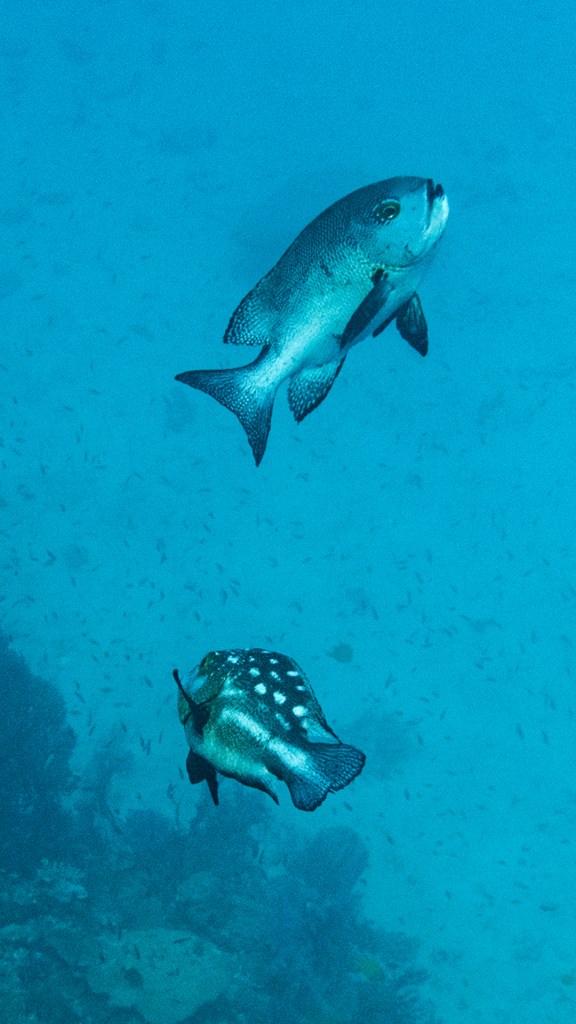
Here is a different species showcasing colour changes. The adult black snapper (top) looks very different from the juvenile phases (bottom) which look like they inspired the American flag, their bodies covered in an assortment of black and white spots and stripes.
Behind the lens.
Firstly I apologise to all my fans (mostly my grandparents) for the lack of publication last week, I was unhappy with the draft I had written and threw it inside the vault, taking some much needed time for myself instead of repairing what I thought of at the time as the scrapheap of the blogging world.
The time which I made for myself went towards leaning about taking pictures of a higher quality, editing them to bring out their best shapes and colours, and browsing the internet pretending to spend thousands of dollars on new equipment which would sooth my consumerist urges. My love for photography is growing daily and its link to the science of light underwater from the perspective of both the images I take, and the adaptation of my subjects, is the stimulation I need to keep me occupied. I hope you find my analysis of this subject and intriguing as I do.
I hope that over the course of these blogs you will notice an improvement to the images I am able to create, and that I will eventually be able to catalogue some of this rarely documented behaviour which I am fortunate enough to witness during my days at sea.
Sending love to everyone who knows that I wish to send it to them, and I miss you all. I hope you enjoyed this light and colour inspired episode. Thank you for your continued support, it means the world to me ❤ .


 Sam Snaaps
Leave a comment